
Research Discovery
Search Publications
Search published legal research by paper title, author, abstract, keywords, DOI, publication year, volume and issue.
Search Results
3,968 publications

Open Access
FOOD SECURITY LAW IN INDIA: AN ENDEAVOUR TO TACKLE THE PROBLEM OF HUNGER THROUGH LEGISLATION BY - S. KALAIVANI
[1] Boutros Boutros-Ghali, Special Address - Ending Hunger: A Global Concern, Conference on Overcoming Global Hunger, Washington DC, November 30, 1993.
[2] http://www.righttofood.org/work-of-jean-ziegler-at-the-un/what-is-the-right-to-food/ Last visited on May 10, 2016 at 1110 hours.
[3] General Comment No. 12 of the United Nations (UN) Committee on Economic, Social and Cultural Rights. Available at http://www.ohchr.org/EN/Issues/Food/Pages/FoodIndex.aspx Last visited on May 11, 2016 at 1700 hours
[4] Multilateral treaty adopted by the UN General Assembly on December 16, 1966. It came into force on January 3, 1976 and commits its parties to work toward the granting of economic, social, and cultural rights to the Non-Self-Governing and Trust Territories and individuals, including labour rights and the right to health, the right to education and the right to an adequate standard of living. As of 2016, the Covenant has a total of 164 parties and another six countries, including the United States(US), have signed but not ratified the Covenant. 25 countries, most notably Malaysia, have neither signed nor ratified the Covenant. It forms a part of the International Bill of Human Rights, along with the Universal Declaration of Human Rights (UDHR) and the International Covenant on Civil and Political Rights (ICCPR), including the latter's first and second Optional Protocols. It is monitored by the UN Committee on Economic, Social and Cultural Rights (UNCESCR). Available at http://www.ohchr.org/EN/ProfessionalInterest/Pages/CESCR.aspx Last visited on July 1, 2017 at 0900 hours.
[5] Lidija Knuth and Margret Vidar, Constitutional and Legal Protection of the right to food around the World, p. 32 (FAO, Rome, 2011).
[6] Held at the headquarters of the Food and Agriculture Organisation of the UN (FAO) in Rome, Italy from November 13-17, 1996 in response to the continued existence of widespread undernutrition and growing concern about the capacity of agriculture to meet future food needs. This Summit witnessed participation from almost 10,000 participants from 185 countries and the European Community, and provided a forum for debate on one of the most important issues facing world leaders in the new millennium - the imperative of eradicating hunger. The 'Rome Declaration on World Food Security' and the 'World Food Summit Plan of Action' were two outcomes of this summit, and it provided a framework for bringing about important changes in policies and programmes that were needed to achieve 'Food for All'. Available at http://www.fao.org/WFS/ Last visited on July 4, 2017 at 1600 hours.
[7] Supra Note 2 at p. 1
[8] Pooja Ahluwalia, "The Implementation of the right to food at the National Level: A Critical Examination of the Indian Campaign on the right to food as an Effective Operationalization of Article 11 of ICESCR", CHRGJ Working Paper No. 8 (New York, 2004).
[9] Francis Ng and M. Ataman Aksoy, "Who Are the Net Food Importing Countries?", Policy Research Working Paper No. 4457 (World Bank Development Research Group, Washington DC, January 2008).
[10] Supra Note 8 at p. 2.
[11] AIR 1980 SC 1579.
[12] In every prison, there is the institution of the Board of Visitors which includes judicial and administrative officers and also members of the public. Such members include District & Sessions Judges, District Magistrates and Sub-Divisional Magistrates among the members. Bureau of Police Research and Development, Model Prison Manual for the Superintendence and Management of Prisons in India, p. 287 (New Delhi, 2003).
[13] (1982) 2 SCC 494
[14] Supra Note 15 at p. 6.
[15] Formerly known as Central Hindu College, is one of the oldest higher education institutions in India and serves as a public central university located in Varanasi, UP. Established in 1916 by Pt. Madan Mohan Malaviya, with over 12,000 resident students, it claims the title of the largest residential university in the whole of Asia. Its main campus is spread over 1,300 acres (5.3 sq. km) and was built on land donated by the hereditary ruler of Banaras and its south campus spread over 2,700 acres (11 sq. km), hosts the Krishi Vigyan Kendra (Agriculture Science Centre) and is located about 60 km (37 miles) away from Banaras. It celebrated its centenary year in 2015-2016. Available at http://www.bhu.ac.in/ Last visited on January 12, 2018 at 1900 hours.
[16] AIR 1987 SC 1802.
[17] 3 Constitution of India, Article 39: Certain principles of policy to be followed by the State:
[18] AIR 1989 SC 677.
[19] Supra Note 43 at p. 13.
[20] AIR 1990 SC 630.
[21] Supra Note 552 at p. 107.
[22] AIR 1996 SC 1051
[23] AIR 1995 SC 142.
[24] (2010) 170 DLT 476 (DB).
[25] It is one of the five types of writs which can be issued by courts in India, and means 'we command' in the Latin language. It is issued by a superior court to compel a lower court or a government officer to perform his / her mandatory or purely ministerial duties correctly. The word 'mandamus' has appeared in a number of orders issued by the sovereigns of England in the years following the Norman Conquest, and the first instance of a mandamus being used to enforce the right of a private citizen was seen in the year 1615. Available at http://www.legalservicesindia.com/article/592/Analysis-Of-WritOf-Mandamus.html Last visited on November 4, 2018 at 1145 hours.
[26] (2010) 172 DLT 9.
[27] (2011) 125 DRJ 173.
[28] (2013) 2 SCC 688
[29] Supra Note 442 at p. 85.
[30] Supra Note 385 at p. 73.
[31] Writ Petition (Civil) No. 857 of 2015
[32] NFSA, Sec. 14: Internal grievance redressal mechanism: Every State Government shall put in place an internal grievance redressal mechanism which may include call centres, help lines, designation of nodal officers, or such other mechanism as may be prescribed.
[33] NFSA, Sec. 15: District Grievance Redressal Officer: (1) The State Government shall appoint or designate, for each district, an officer to be the District Grievance Redressal Officer for expeditious and effective redressal of grievances of the aggrieved persons in matters relating to distribution of entitled foodgrains or meals under Chapter II, and to enforce the entitlements under this Act.
[34] NFSA, Sec. 16: State Food Commission: (1) Every State Government shall, by notification, constitute a State Food Commission for the purpose of monitoring and review of implementation of this Act
[35] Order dated August 31, 2010 of the Hon'ble Supreme Court of India in Writ Petition (Civil) No. 196 of 2001 titled PUCL v. Union of India & Ors. Available at https://www.sci.gov.in/jonew/bosir/orderpdfold/1148757.pdfLast visited on October 11, 2018 at 1130 hours.
[36] Supra Note 389 at p. 74.
[37] Supra Note 36 at p. 10
[38] Supra Note 390 at p. 74.
[39] Order dated September 6, 2010 of the Hon'ble Supreme Court of India in Writ Petition (Civil) No. 196 of 2001 titled PUCL v. Union of India & Ors. Available at https://www.sci.gov.in/jonew/bosir/orderpdfold/1151015.pdf Last visited on October 1, 2018 at 1500 hours.
[40] Supra Note 20, See 10.
[41] Supra Note 21 at p. 7.
[42] Id
[43] Supra Note 518 at p. 101.
[44] undernourished and nearly all of them live in developing countries. Available at http://www/fao.org/nens/story/en/item Last visited on July 23, 2016 at 1330 hours
[45] Writ Petition (Civil) No. 196 of 2001 filed before the Hon'ble Supreme Court in April 2001 following a large number of starvation deaths in the state of Rajasthan. The matter was argued by noted Senior Advocate Colin and alleged that these persons were deprived of the required employment and food relief as mandated by the Rajasthan Famine Code of 1962. This case took place at a time when the parts of the country continued to face hunger and malnutrition. The Apex Court, through a series of directions in this matter from 2001 onwards, has attempted to lay down the law with regards to ensuring nutritional security in the country. Available at http://www.pucl.org/reports/Rajasthan/2001/starvation-writ.htm Last visited on July 17, 2016 at 1540 hours
[46] Order dated September 17, 2001 of the Hon'ble Supreme Court of India in Writ Petition (Civil) No. 196 of 2001 titled PUCL v. Union of India & Ors. Available at http://supremecourtofindia.nic.in/jonew/bosir/orderpdfold/18655.pdf Last visited on April 19, 2017 at 2300 hours.
[47] Order dated August 12, 2010 of the Hon'ble Supreme Court of India in Writ Petition (Civil) No. 196 of 2001 titled PUCL v. Union of India & Ors. Available at http://supremecourtofindia.nic.in/jonew/bosir/orderpdfold/1139485.pdf Last visited on March 1, 2018 at 2300 hours.
Open Access
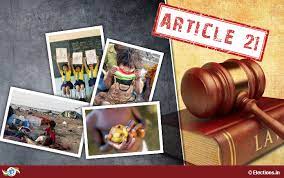
RIGHT TO LIFE AND PERSONAL LIBERTY UNDER ARTICLE 21: A BRIEF STUDY OF ITS MEANING AND DYNAMIC SCOPE WITH THE HELP OF CASE LAWS. BY - MUSKAN SHARMA & DEEPAK BAISLA
[1] Utkarsh Yadav, Article 21: A Comprehensive Journey Of Right To Life And Personal Liberty, Indian Journal of Integrated Research in Law, Volume I Issue II | ISSN: 2583-0538.
[2] Swapnil Pattanayak, The Aspects And Provisions Of Personal Liberty Under Article 21 Of The Constitution Of India-A Detailed Study, 2019 IJLMH | Volume 2, Issue 4 | ISSN: 2581-5369.
[3] Piyasha Das, The Critical Analysis On Interpretation of Article 21 Of The Indian Constitution, 2020 IJLMH | Volume 3, Issue 5 | ISSN 2581-5369.
[4] Nisha Gandhi, Expanding And Evolving The Ambit Of Article 21 Of The Constitution Of India With The Developing Scenario, Volume II Issue IV | ISSN: 2583-0538.
[5] Munn vs Illinois, 94 U.S. 113 (1876).
[6] AIR 1950 SC 27.
[7] 1978 AIR 597.
[8] Supra note 6.
[9] AIR 1989 SC 549.
[10] 1992 SCC (3) 666.
[11] (1993) 1 SCC 645.
[12]
[13] 1996 AIR 114.
[14] (1996) 2 SCC 549.
[15] 1964 SCR (1) 332.
[16] AIR 2017 SC 4161.
[17] AIR 1979 SC 1369.
[18] (1996) 5 SCC 647.
[19] 1991 SCR (1) 5.

Open Access
ANALYSIS OF MARITIME LAW AND POLICY IN INDIA AND UAE BY - ADV. GURKIRAT SINGH
[1] www.investopedia.com
[2] www.marineinsight.com
[3] www.un.org
[4] Wits.worldbank.org
[5] cmlnluo.law.blog
[6] http://shipmin.gov.in/
[7] http://shipmin.gov.in/
[8] The Registration of Ships Act 1841
[9] The Territorial Waters, continental Shelf, Exclusive Economic Zone And Other Maritime Zones Act,1976
[10] wits.worldbank.org
[11] www.dubaichamber.com
[12] The UAE Maritime Law,1981
[13] The UAE Maritime Law,1981

Open Access
GENDER GAP IN INTELLECTUAL PROPERTY: WOMEN'S PERSPECTIVES By -Raj Kumar Garg & Satwik Sankhyan
[1] The key phrase in the research paper is “lost Einsteins.” It’s a reference to people who could “have had highly impactful innovations” if they had been able to pursue the opportunities they deserved, the authors write.
[2] Information available at : https://depot-de-marque.com/en/women-and-property-intellectual/
[3] Gender equality and IP, WIPO, available at : https://www.wipo.int/women-and-ip/en/news/2020/news_ 0001.html.
[4] Power and decision making, UN stats, available at : https://unstats.un.org/unsd/gender/chapter5/chapter5.html.
[5]Information available at: https://www.copyright.gov/policy/women-in-copyright-system/Women-in-the-Copyright-System.pdf
[6] Information available at: https://www.copyright.gov/policy/women-in-copyright-system/Women-in-the-Copyright-System.pdf
[7] Ibid
[8] According to the World Economic Forum's 2022 Global Gender Gap Index, India is ranked 135th out of 146 nations. With a ranking of 146 in the "health and survival" subindex, the nation performs the poorest globally. Metrics including the literacy rate and the enrollment rates in primary, secondary, and higher education are included in the report's sub-index. India comes in at number 107 out of 146, and its ranking has slightly declined from the previous year. India came in at number 114 out of 156 in 2021.
[9] World Bank. 2022. Women, Business and the Law 2022. Washington, DC: World Bank. License: Creative Commons Attribution CC BY 3.0 IGO, Reports, Key Findings - Women, Business and the Law - World Bank Group.
[10] Achieving Gender Equality and Empower all Women and Girls, Department of Economic and Social Affairs Sustainable Development, United Nations, Information available at : https://sdgs.un.org/goals/goal5.
[11] Information available at : https://www.google.com/search?q=modern+female+inventors. In the fall of 1893, she applied for a patent for an invention that would help divers in many ways. This was an invention of the car heating system. The patent was registered on November 28, 1893,
[12] Ibid
[13] Information available at: https://en.wikipedia.org/wiki/Nancy_Maria_Donaldson_Johnson. The invention was patented in 1843 and was the first of its kind, but Nancy sold it off cheaply. Johnson's impact on society is significant. Her invention transformed the ice cream industry, making it possible to produce and sell ice cream on a large scale. The invention also created new opportunities for entrepreneurs and small business owners, making it possible for them to start their own ice cream shops and businesses.
[14] Information available at:https://timeline.com/woman-solar-power-leader-f682bb7c6feb
[15]Information available at: https://novaxnetwork.com/ann-tsukamoto-the-woman-inventor-whose-invention-saved-many/
[16] Hopper is best known for her trailblazing contributions to computer programming, software development, and the design and implementation of programming languages. A maverick and an innovator, she enjoyed long and influential careers in the U.S. Navy and the computer industry
[17] Information available at:https://www.afpm.org/newsroom/blog/women-who-made-future-possible
[18]Information available at: https://www.sciencehistory.org/historical-profile/stephanie-l-kwolek
[19] Information available at:https://www.dpma.de/english/our_office/publications/ingeniouswomen/
110jahrekaffeefilter/ index.html
[20]Information available at: https://www.indiatimes.com/trending/social-relevance/inventions-by-women-537522.html?picid=2093792
[21] Ibid
[22] The World Intellectual Property Organization (WIPO; encouraging the protection of IP throughout the world) celebrates April 26 as World IP Day every year to promote knowledge about various IP related matters like trademarks, copyrights, patents, etc., along with the crucial role they play in promoting innovations. This year, the theme of this day was, “Powering change: Women in innovation and creativity” for celebrating women and their role in shaping the future of the world economy.Information available at https://www.kashish world.com/blog/how-can-intellectual-property-rights-empower-women/
[23] Ibid. Developing countries with weak IP regimes and high population exacerbate disparate living conditions for women. Moreover, they also tend to have higher levels of female unemployment, lower female education rates, and higher infant mortality rates. However, protecting IP can surely change this as the nation that protects IP Rights is also known for its terrific entrepreneurial environment for women. While developed nations usually have more grounded IP protection laws as compared to the developing nations, still they can make efforts to improve the IP protection for women. As per the Women’s Institute for Policy Research, women have quintupled their portrayal among the patent holders since 1977. But, on the other hand, studies and reports have also suggested that women contribute only to 7.7% of primary inventors who own patents.
[24] Andaman and Nicobar provides monthly allowance of 20,000 INR per month to start-ups by women for a period of one year, similarly in Bihar start-ups owned by women get 5 percent additional grant other than the limit fixed under Start-up India initiative. These incentives significantly contribute to more women entrepreneurs to participate in business and the IP system.
[25] Information available at : https://www.oecd.org/dac/gender-development/investinginwomenandgirls.html.
[26] Implementing support systems based with helplines to address user queries and grievances. These can be one among few practical improvements in the system which can effectively introduce and encourage more women entrepreneurs to enter the IP regime.
[27] Greg Satel, Why We Need Women To Have Larger Role In Innovation, Inc., (Nov 17, 2018), Information available at : https://www.inc.com/greg-satell/why-we-need-women-to-have-a-larger-role-in-innovation.html.
[28] Jonathan Woetzel, Anu Madgavkar, Kweilin Elingrud, Eric Labaye, Sandrine Devillard, Eric Kutcher, James Manyika, Richard Dobbs, and Makala Krishnan, How advancing women’s equality can add $12 trillion to global growth, McKinsey & Company (Sept 1, 2015), Information available at : https://www.mckinsey.com/featured-insights/employment-and- growth/how-advancing-womens-equality-can-add-12-trillion-to-global-growth#.
[29] The Cost of Gender Gap in Agricultural Productivity in Malawi, Tanzania and Uganda,
UN Women, the United Nations Development Programme–United Nations Environment Programme Poverty- Environment Initiative (UNDP-UNEP PEI) Africa, and the World Bank. The collaboration was led by UN Women, Eastern and Southern Africa Regional Office (ESARO) (2015), http://documents1.worldbank.org/curated/en/8 47131467987832287/pdf/100234-WP-PUBLIC-Box393225B-The-Cost-of-the-Gender-Gap-in-Agricultural- Productivity-in-Malawi-Tanzania-and-Uganda.pdf.
[30] Jonathan Woetzel, Anu Madgavkar, Rajat Gupta, James Manyika, Kweilin Ellingrud, Shishir Gupta, and Mekala Krishnan, The power of parity: Advancing women’s equality in India, McKinsey & Company (Nov 1, 2015), https://www.mckinsey.com/featured-insights/employment-and-growth/the-power-of-parity-advancing-womens- equality-in-india.
[31] Kamil Idris, Intellectual Property: a power tool for economic growth, World Intellectual Property Organization .
https://www.wipo.int/edocs/pubdocs/en/intproperty/888/wipo_pub_888.pdf.

Open Access
ANALYSIS ON TEHSEEN S POONAWALLA VS. UNION OF INDIA BY - B THILLAI NAYAGE
[1] Tehseen S Poonawalla v. Union of India, (2018) 9 SCC 501
[2] Priyadarshee Mukhopadhyay, The Epidemic of Mob Lynching in India: Analysing Tehseen S. Poonawalla v. Union of India, CCLSNLUJ, (NOVEMBER 04, 2023, 10.00 AM) https://criminallawstudiesnluj.wordpress.com/2020/02/11/the-epidemic-of-mob-lynching-in-india-analysing-tehseen-s-poonawalla-v-union-of-india/
[3] Suraj Kumar, 'Vigilantism Not Permissible': Supreme Court Seeks Data From Govts On Action Taken To Stop Mob Lynching, LIVELAW, (NOVEMBER 06, 2023, 10.00 AM) https://www.livelaw.in/top-stories/supreme-court-india-vigilantism-mob-violence-preventive-remedial-measures-232399
[4] Tehseen S Poonawalla v. Union of India, (2018) 9 SCC 501
[5] Suraj Kumar, 'Vigilantism Not Permissible': Supreme Court Seeks Data from Govts on Action Taken to Stop Mob Lynching, LIVELAW, (NOVEMBER 06, 2023, 11.00 AM) https://www.livelaw.in/top-stories/supreme-court-india-vigilantism-mob-violence-preventive-remedial-measures-232399
[6] Tehseen S Poonawalla v. Union of India (2018) 9 SCC 501
[7] Tehseen S Poonawalla v. Union of India, (2018) 9 SCC 501
[8] Khushi Saxena, ANALYSIS OF TEHSEEN S. POONAWALLA V UNION OF INDIA 2018, VOL. 1 ISSUE 4, Journal of Legal Research and Juridical Sciences, https://jlrjs.com/wp-content/uploads/2022/05/30.-Khushi-Saxena.pdf
[9] Geetika Rathore, MOB LYNCHING: A Desecration of the Rule of Law, Volume 1, issue 1, CALR, (2021), https://calr.in/mob-lynching-a-desecration-of-the-rule-of-law/.
[10] Khushi Saxena, ANALYSIS OF TEHSEEN S. POONAWALLA V UNION OF INDIA 2018, VOL. 1 ISSUE 4, Journal of Legal Research and Juridical Sciences, https://jlrjs.com/wp-content/uploads/2022/05/30.-Khushi-Saxena.pdf
[11] Ananya Bhardwaj, NCRB stopped collecting data on lynching, hate crime as it was ‘unreliable’ Govt tells LS, ,THE PRINT, (NOVEMBER 07, 2023, 10.30 AM), https://theprint.in/india/governance/ncrb-stopped-collecting-data-on-lynching-hate-crime-as-it-was-unreliable-govt-tells-ls/785201/ .